For years, Nepali cinema had an almost fixed idea of what a “hero” should look like: tall, well-built, conventionally handsome, able to dance and fight. Dayahang Rai did not fit neatly into that mould. Instead, his arrival helped widen it.
Born on April 13, 1980, in Khawa village of Bhojpur, Rai is now 46. When he came to Kathmandu, becoming a film star was not part of any clearly mapped-out plan. Accounts of his early life say he arrived in the capital with thoughts of becoming a lahure, or joining military service abroad. But literature, theatre and the company of artists gradually pulled him in another direction.
That change of direction eventually changed Nepali cinema too.
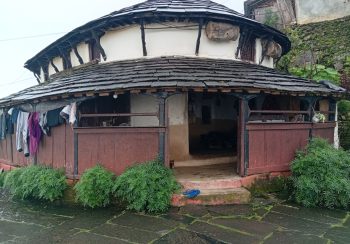
One of the most enduring threads in Rai’s childhood is tied to the stories his mother used to tell him. He grew up in an agrarian village in Nepal’s eastern hills, where folk tales, the natural landscape, radio and literature helped shape his imagination. Years later, speaking about his relationship with nature, he said, “Growing up in an agrarian village in eastern Nepal, I’ve always been inspired by nature in whatever I do, including acting.”
In that sense, his first school of acting was not simply a formal training space. It was also the village where he grew up.
Journalism led him to Kathmandu, theatre pulled him in
Rai moved to Kathmandu in 2001 and enrolled to study journalism at Ratna Rajyalaxmi Campus. The classroom, however, could not compete with his growing attraction to theatre. Acting training, plays and literary circles gradually drew him deeper into the stage.
He later joined friends in establishing Mandala Theatre. It was not simply a place for them to perform. It became an important space where a new generation of actors could learn, rehearse and eventually find their way into cinema.
Rai has explained the need for Mandala in practical terms. Rehearsing in school grounds during holidays or spending hours discussing plays in tea shops was not a sustainable way to work. They needed a space of their own.
He has summed up his relationship with theatre in even simpler words: “The stage is my home.”
That sentence offers one of the clearest ways to understand Rai. Cinema gave him popularity, but theatre shaped the actor he became.
When Loot changed the game
Rai had already appeared in films including Anagarik, Mero Euta Saathi Chha and Dasdhunga. But Loot, released in 2012, became the turning point.
His character Gofle made him a household name.
Rai later said he had hoped the film would introduce him to a wider audience, but he had not expected it to become such a phenomenon.
The success of Loot was not only the story of one actor’s breakthrough. It came at a moment when Nepali audiences were beginning to accept central characters who looked and behaved more like the people around them.
Then came Kabaddi.
Released in 2014, the first Kabaddi introduced Rai as Kaji, a stubborn, comic and deeply human man repeatedly unlucky in love. The character went on to become one of the most recognisable figures in contemporary Nepali popular culture. The franchise eventually stretched across four films.
Yet reducing Rai to Kaji would leave out much of what makes his career significant. In films such as Dasdhunga, Sambodhan, Talakjung vs Tulke, White Sun, Jaari and A Road to a Village, he has played characters drawn from very different social and psychological worlds.
He has won three National Film Awards: Best Supporting Actor for Dasdhunga, and Best Actor for Sambodhan and Kabaddi Kabaddi.
The star who succeeds by looking ordinary
There is an intriguing contradiction at the heart of Rai’s popularity. He is a star, but on screen he rarely tries to look like one.
His characters get angry, become confused, lose in love, act selfishly and make ridiculous mistakes. They feel less like extraordinary figures and more like people one might encounter in a village, marketplace, bus station or tea shop.
That is perhaps why an older piece of advice Rai once gave aspiring actors now sounds especially fitting. He had warned them not to consider merely getting a film role a major achievement. The real task, he said, was to build an identity with audiences through hard work.
Rai himself became an example of that idea.
His success also challenged the visual conventions of the Nepali film hero. His career demonstrated that credibility as a character could matter more than fitting an established image of male stardom.
Beyond the screen, into the forest
There is another side of Rai that receives less attention than his films: conservation.
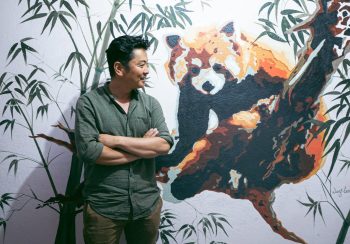
On September 19, 2020, he became a conservation ambassador for the Red Panda Network. Despite growing up in eastern Nepal, Rai says he never saw a red panda in the wild during his childhood.
He has also never tried to present himself as an expert on the animal’s scientific aspects. Instead, he has said that he can use his public profile to help take the message of conservation to a wider audience.
Even here, his instinct returns to performance. Rai has spoken about creating a play about red pandas and even exploring whether a cultural form inspired by the animal could be developed, much as traditional dances have drawn inspiration from other wildlife.
That relationship did not end with the ambassadorship. On May 22, 2024, Mandala Theatre and the Red Panda Network collaborated on a three-and-a-half-minute musical awareness production. Rai said artists, too, needed to take conservation issues seriously.
Still moving at 46
Rai is hardly at the stage of sitting back and writing the story of a finished career.
His latest film, Pension Patta, opened on September 11, 2026. Directed by Maotse Gurung, the film explores a lahure family through questions of pension, generational relationships and family responsibility. It began its theatrical run with more than 200 shows across Nepal.
Rai’s own comments about the film also reveal what he looks for in a story. Nepali society has heard many stories of the bravery and success of lahures, he has said, but much less about the family tensions that emerge after retirement and the ways pensions can affect relationships.
For Rai, Pension Patta is not simply a story about lahure families. It is also a story about Nepali society.
That is why Rai’s journey is more interesting than the familiar inspirational formula of a village boy who became a star.
It is also the story of Nepali cinema learning to look differently at its own people.
There was a time when the film hero often seemed slightly removed from the audience, almost an idealised figure. Many of Rai’s characters instead came and sat beside that audience: sometimes as Kaji, sometimes as Gofle, sometimes as a father, a farmer or an ordinary man struggling within society.
Perhaps that is why the best way to understand Dayahang Rai is not simply to look at his face, but at all the faces he has chosen to inhabit.
In them are Nepal’s villages, unfinished romances, tangled families, laughter and defeat, and the confidence that an ordinary life, too, is worthy of the centre of the screen.